Red flag

TALLADEGA, Ala. – Over the rolling Alabama hills, the soft autumn breeze still whistles through Dixie, finding a legendary track on race week and a sea of flags to push and pull – American flags, driver flags and the flag that remains the third rail of NASCAR, the Confederate.
In America, a NASCAR race is the last major sporting event where the Stars and Bars is still so prevalent, still so prominent, and while the debate over whether the flag's presence is appropriate isn't new, the stakes for NASCAR continue to get higher.
After a decade of massive growth, NASCAR's popularity has slowed and television ratings have slumped. To restart its progress, NASCAR must continue to attract new fans in fresh, more diverse markets, many of whom view the Confederate flag as a symbol of racism and oppression. Yet NASCAR doesn't want to alienate its loyal base, many of whom view the waving flags in the infield as a symbol of honor, history and traditional Southern pride.
Which is why the flag issue – symbolic of many others including prerace prayer and moving races out of the South to fresh markets in the North, Midwest and West – remains an issue NASCAR can't easily solve.
A year ago NASCAR CEO Brian France condemned the flag on "60 Minutes" and reiterated his company's "commitment to diversity."
But that has done little to pull the flags down here at Talladega; they were out in force all weekend, hung from homes and trees on the drive to the track, placed in the back windows of trucks and cars and run up makeshift flag poles on motor homes throughout the party-packed infield.
In fact, France even may have strengthened the resolve to keep them flying.
And France's comments – "It's not a flag that I look at with anything favorable, that's for sure," he said – have not been publicly embraced or repeated by people with the most influence over fans: the drivers themselves.
Yahoo! Sports asked more than 30 major drivers for their thoughts on the Confederate flag, whether they felt it created an unwelcoming environment to potential fans, and if so, whether it would be appropriate to ask their supporters to not fly it.
All but one turned down requests for private interviews, written statements or any comment on the issue. Many did so tersely.
The only driver we found willing to speak on the issue during Talladega race week was Dale Earnhardt Jr., the sport's most popular and powerful star who holds tremendous sway over his legion of fans. Earnhardt, who previously has expressed concern over the flag's meaning, hardly made a definitive statement, but at least had the guts to say something.
"We live in a country where you can speak freely and do as you may," Earnhardt said. "I don't know [if] what that flag stands for is the same for me as it is the guy who might have it flying out there.
"I am not going to agree with everything everybody does all my life. So I don't have any control over it."
When that is the best you can get out of nearly three dozen supposedly fearless, independent and talkative drivers, the silence is as telling as the sagging TV numbers.
NASCAR still has a flag (and image) issue. But no one wants to discuss the elephant in the infield.
Twenty-nine races into the 2006 NASCAR season and television ratings have been either down or flat in 27 of them (numbers for Sunday's UAW-Ford 500 run here at Talladega Superspeedway have not been released). Not even the highly publicized Chase for the Nextel Cup, the sport's championship system, has held audiences. Not since Martinsville in April has a telecast's numbers improved year over year.
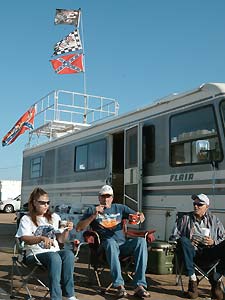 Local fans bring the flag. (Chip English) |
Some weeks the drops have been precipitous – down 14.5 percent for the first New Hampshire race, 12 percent for the second, a Chase race no less. Kansas, also a Chase race, was off 11 percent.
Still, NASCAR remains highly popular. It still gets sizable television numbers that all but the NFL would kill for. The circuit is still awash in sponsorship and endorsement money and continues to attract the best drivers from other racing leagues.
Most importantly, it still is exponentially bigger than it was a decade ago, when it experienced a monumental surge in popularity. In no way is it a business in trouble.
But in terms of sustained growth, the television numbers at least suggest that the boom period is over.
France long has pointed to attracting new fans as the key to NASCAR's future and has said he personally spends part of each day working on diversity issues. NASCAR has numerous fan, driver and mechanic outreach programs geared toward minorities and is pouring major money into each initiative.
But while statistical evidence is not available, few believe the programs have significantly changed the racial makeup of the grandstands on race day. While there is no definitive study showing that NASCAR's image – hurt by the Confederate flag – is keeping would-be fans away, common sense says it can't help.
For many minorities, as well as many whites, a sporting event where Confederate flags still flap freely is an unwelcoming and negative place.
"For a lot of people it is a very loaded symbol that has a history of enslavement and hostility built up into it," said Marsha Houston, a professor at the University of Alabama who specializes in interracial communications.
"African-Americans find it very difficult to separate this history from the symbol itself," said Houston, who is black. "They also see people displaying the symbol as being racist, bigoted and anti-black. As a scholar I understand that symbols have multiple meanings and don't have the same meaning to everyone.
"But personally, [if I saw it at a track], I would go home," she said. "I try not to encounter people who display the flag in the back of their truck. My personal feeling is it is an affront to me."
The debate over what the symbol means and who gets to define that meaning has been waged for decades. The issues surrounding the flag are as complex as they are emotionally charged. The arguments some proponents of the flag make are varied, intellectually sound and mature and, if the flag flapped in a vacuum, convincing.
"It's been used in racist ways, but no symbol has one meaning," said John Coski, author of the book "The Confederate Battle Flag – America's Most Embattled Emblem" and a historian at the Museum of the Confederacy in Richmond, Va.
The essential argument of flag proponents is summed up on popular bumper stickers – "it's heritage, not hatred." Some people see the flag as a way to honor deceased Confederate soldiers or relatives who stood up for a cause they believed was just. Others view the flag as a symbol of regional pride.
They point out that the flag was not the official flag of the Confederacy (it was a battle flag) and was never meant to symbolize oppression or racism.
"Because the symbol has been used [in] racist, segregationist ways does not mean everyone used it that way," Coski said.
That came during the 20th century when the Ku Klux Klan and less violent pro-separation groups used it. But, proponents argue, just because the flag was hijacked doesn't mean the hijackers should be allowed to define it.
"They argue, 'It's been co-opted but why should we cede the flag?'" said Coski, who wrote a dispassionate, heavily researched and evenhanded book. "The Ku Klux Klan has used the American flag and the Christian cross for far, far longer."
Houston agrees with this assessment, as most thinking people should.
"It is possible that to some it is a symbol of just regional pride, pride in history and devoid of the negative history of slavery and lynchings," she said.
But as noble as that may be, I don't believe that is the true goal of people waving it at a stock car race. At a Confederate memorial or grave site? Sure. But at a sporting event?
Moreover, while the history is clear, so too, for most, is the present. A symbol does not get to define itself; society's oft-changing reaction to it determines that.
The swastika has been used for 3,000 years in cultures as different as China, India, Japan and Europe. Its literal meaning in ancient Sanskrit comes from the words "su" meaning "good," "asti" meaning "to be," and the suffix "ka."
But once Adolph Hitler's Nazi political party in Germany seized it as a symbol in the 1920s and went on to wage the Holocaust on Jews, it changed. In no way can anyone argue it still means "to be good." Its original intent no longer matters.
The same applies for the Confederate flag.
"The people who love the flag have to understand the negative connotation is not made up, they are based on historical uses," Coski said. "Not just by the Klan but ordinary Southerners who used it just as blacks perceive they do. People who love the flag have to be honest about it."
Coski argues it is unfair to label everyone flying the flag as a racist, and I agree. We both believe most who display the flag do so out of rebelliousness, not racism.
"The symbol has gone from the rebel of the civil war to what a colleague of mine called 'the symbolic middle finger,'" Coski said. "It's a gesture that, ‘I'm tough, I'm independent, I can't be pushed around.'"
Which is fine, but for anyone to ignore that the symbol deeply troubles and frightens others is ignorant and hostile. Plus, it runs counter to the high-minded defense that is all about honoring the past.
"The symbolic middle finger is a far cry from 'it's heritage, not hatred,'" Coski said.
NASCAR, based on the television ratings of its "Super Bowl" race – February's Daytona 500 – has about 37 million fans in America – maybe a few million more if you believe someone can be a fan and miss the biggest event of the year.
Either way, that number is far lower than NASCAR's long-claimed 75 million fans, which never has stood up to reality.
To a great number of potential fans, everyone acknowledges, the sport deals both positively and negatively with the lingering image of the sport as a rural, Southern pursuit. The image of the good ol' boy lives on, no matter how increasingly wealthy and geographically diverse the fans and drivers are.
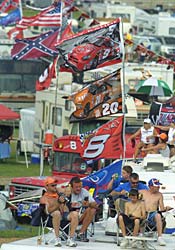 Flags at Talladega. (AP) |
Much of the negative part of that comes from the flag.
"When it was first built it was a Southern sport," said NASCAR legend Donnie Allison, who first raced in the late 1950s. "And when you are in the South the Confederate flag was a symbol of the South. It wasn't a racist thing. That was a flag that you flew."
Outside the South, the number of Confederate flags at races is low. But here, and at other traditional tracks in the region, they are everywhere. A stroll through the infield found multiple flags in every view, often hung by fans from the same flag pole as a flag of their favorite driver.
NASCAR, under France, has banned the flag from appearing in any official capacity or on any licensed product. In the 1990s, when the Sons of Confederate Veterans raised funds to sponsor a car that would feature the flag prominently, NASCAR denied the group's entry into the sport.
Officially there is no debate here.
But getting fans to follow along is a challenge. During the 1990s the University of Mississippi made numerous appeals to its fans to stop waving the Confederate flag at football games. The appeals had little impact, so the school finally banned the sticks that held the flag, citing "fan safety." It held up in federal court and the flag issue has died out at Ole Miss games.
But NASCAR would struggle to make that work in its massive stands and spacious infields. In this case, an Ole Miss-style policy would be not only mistaken but also likely counterproductive.
So while France's position is clear and bold – "I can tell you the flag we get behind: It's the American flag" – it hasn't changed things much. It also has made him unpopular among a segment of his company's costumers.
The reality is few fans are going to listen to the CEO's wishes anyway. If anything, they would act counter to it.
But that, I argue, would not be the case with the drivers. NASCAR fans are famously loyal to their favorite driver, wearing their colors, buying their products, driving their make of car. It is why NASCAR makes so much on sponsorship and 31 Fortune 500 companies are team sponsors.
If all drivers made a declaration against the flag, or even just appealed for a more welcoming environment, surely its numbers would decrease. Or if they chose to support it the opposite would happen. Whatever the answer, it seemed like a worthy question to find out where the drivers stood.
I might as well have asked them to drive without brakes.
"Why are you doing this to us?" demanded one public relations woman. "This is not a story," shouted another, even after I pointed out that the flags are still flying. "Absolutely no way, no how," said another.
Email responses were often bitter. Face-to-face encounters often worse. Interview and statement requests were summarily denied. At some drivers' scheduled weekly press conferences, I was told that any question involving the flag would end the session.
One PR person for a championship-winning driver declared that the driver had no influence over his fans, which ought to be news to his myriad sponsors. Others tried to reason that their drivers were too young. One suggested his guy was just too dumb to really comprehend the subject. I appreciated the off-the-record honesty there.
Some claimed their driver was just too busy. A bunch ignored multiple emails and phone messages. As a group, everyone was running for the hills.
Only Earnhardt was willing to stand up and say anything. He said he doesn't view the flag the way some of his fans do, but considering he has millions of fans of all makes, shapes and political persuasions, he can't expect to agree with all of them on anything. Heck, some of them might even drink Miller Lite.
Going into Talladega, I honestly had no idea what the reaction would be to such a question. What I never anticipated was an almost complete whitewash – pretty much everyone but Junior – which became far more telling than any answer any single driver could have provided.
"We don't want to offend anyone," said one PR woman.
Who are you offending, I'd ask, the people who think it is great to fly the Confederate flag? Or the people who believe that the people who think it is great to fly the Confederate flag are intolerant?
I'd try to note that a "no comment" on this was a comment, support of the status quo.
I'd point out that if Confederate flags were being waved at NBA or NFL games, those players would be asked about it – although, as professor Houston smartly pointed out, you don't see too many athletes taking a stand against Native American team names or logos when those debates come up.
"There is a lot of blindness we all have to the concerns of others," she said.
Essentially I believe, based on so many off-the-record conversations and reactions, that given the choice the drivers would rather offend non-fans than current fans. If you happen to find the flag offensive, they have nothing to say.
But there never was a definitive answer. Maybe there never will be.
In terms of business, though, it's about trying to balance appealing to the people who are at the track with the ones who potentially could be.
The same great freedom that protects the flying of the Confederate flag in this big, beautiful Alabama infield is the same great freedom that allows people troubled by the symbol to ignore it or leave NASCAR altogether.
That's America. And for NASCAR, even after all these years, it's still its greatest challenge.
